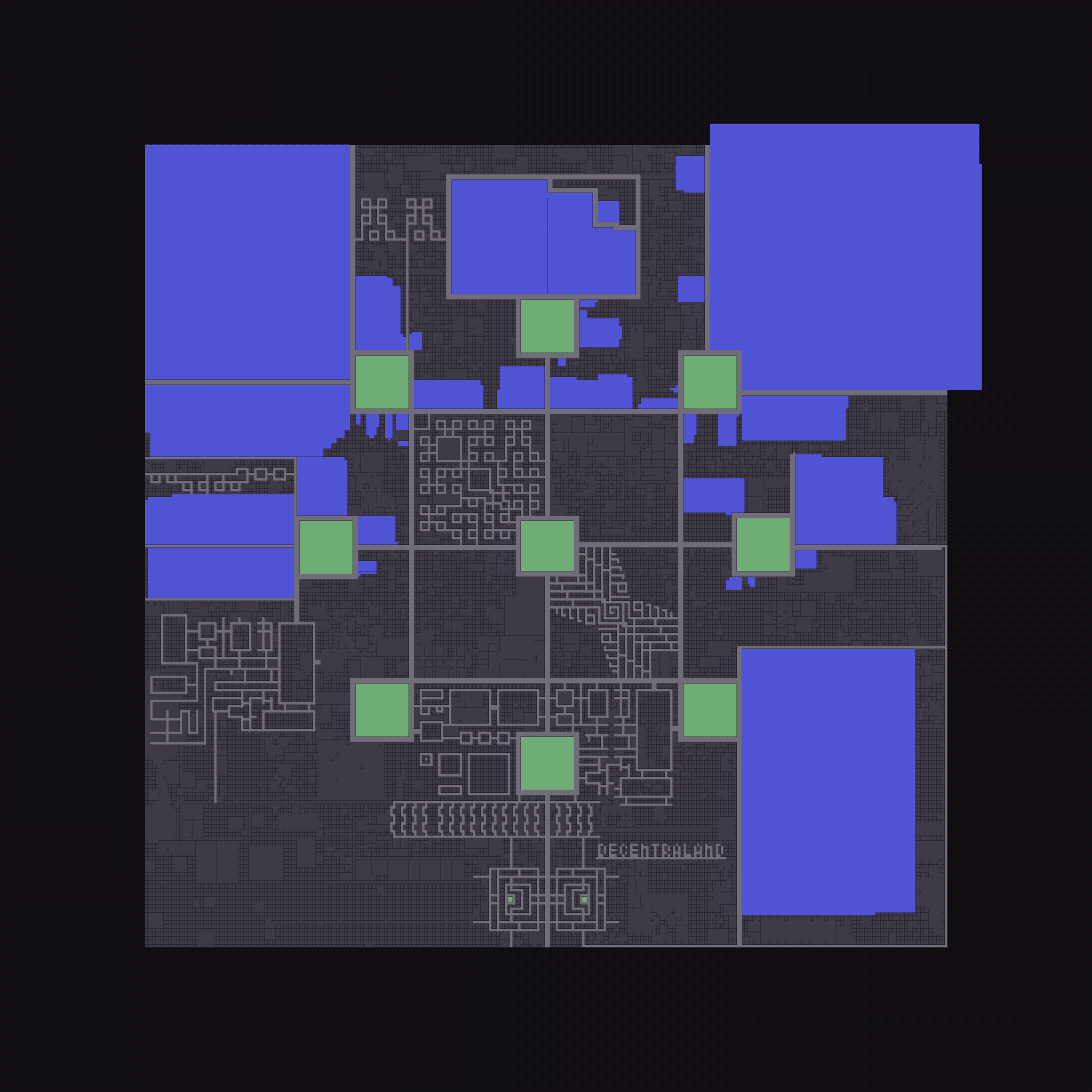
This document serves as reference to outline the boundaries of what the Decentraland protocol
for Explorers is. It defines the common mechanisms and protocols (sometimes including
its messages and serializations) to make that information available to implementers willing to
create their own versions of the Explorer.
What is Decentraland?
Decentraland is an open platform to socialize based on Web3 and public key cryptography. The
users of the platform own the assets and both the governance process and the decisions made
through it. Many different products can be considered part of Decentraland, including but not
limited to a 3D explorer of the world created by the users and its rendering, content,
replication and communication layers. This document focuses on a particular use case and
subset of Decentraland, its Explorer and the protocols required to make it work.
Layers of the Explorer protocol
To describe the Explorer protocol, the layers described in the
Decentraland Whitepaper (2017)
will be quoted. The initial layers were the first three, this document will also introduce a
forth layer: Runtime layer
Consensus layer: Track land ownership and its content.
Content layer: Download assets using a decentralized distribution system.
Real-time layer: Enable users’ world viewers to connect to each other.
Runtime layer: Execute experiences the explorer.
Consensus layer
Decentraland uses smart contracts to maintain a ledger of ownership of each of the (ownable)
assets for the Explorer. The original whitepaper was scoped only to the LAND contract, that
scope increased with the passing of time and the addition of new asset types like Wearables
and Emotes, Names and Estates.
LAND
The
LAND contract
establishes the ownership in the Ethereum network of parcels of land, those are non-fungible
tokens that map 1-to-1 with the Decentraland Map, each token encodes a signed
(x,y) position in the map. We call the map of the LAND contract "Genesis
City". The whitepaper established that each plot of LAND corresponds to 10x10 meters of
virtual land. This was changed to 16x16 meters
using the first governance app.
Names
Names are a crucial part of the Identity, to prevent impersonation and to continue leveraging
smart contracts, Decentraland uses tokenized names using an Ethereum Name Service (ENS)
subdomain .dcl.eth. These names are ERC-721 tokens, that makes them owneable and
transferrable, and they live in Ethereum Mainnet.
Wearables
Wearables are built on top of a variety of smart contracts deployed both to Ethereum (Mainnet)
and Polygon. The first era of wearables still live in Ethereum, we call them L1. Those were
convenient but expensive to operate. To supass this limitation a new technology was developed
"L2 Collections".
Collections are a set of smart contracts deployed to Polygon (or other EVM compatible
networks) to create, manage and own a list of Items.
Items are ERC-721 compatible tokens. Those can be limited in supply and share a
common representation. The representation is the same for each item of the same kind, and it
is used to locate the content of the item for applications like the Explorer or the
Marketplace.
Collections are generic smart contracts that are designed to fulfill a wide variety of use
cases. Starting with wearables, collections were configured to depend on a Wearables committee
to approve/reject the content (representation) of each item. This process is governed by the
Decentraland DAO.
That means that the community decides from the publication and secondary sales fees to the
group of people that curates
the content of the wearables. The curation process happens in the
Builder tool and
it is connected to the
forum.
DAO
Historically, there were many implementations of governance apps for Decentraland. Starting
with
Agora
(off-chain signatures), then Aragon and lastly a
snapshot-based. Nowadays, the governance
process happens entirely in the
Governance App and
on-chain proposals are enacted using Aragon by the
DAO Committee. Their principal
responsibility is to enact binding proposals on-chain like listing Point of Interests, sending
Grants, and any other operations involving the DAO's smart contracts.
Content
layer
The Decentraland Explorer and other applications render representations of the assets from the
consensus layer. The content layer defines the mechanisms in which the content is:
Signed, validated and uploaded to a node
Replicated to other nodes and
Served to the final users
To do so, a content-server was created.
It is a service that runs inside a Catalyst.
A catalyst node is a bundle of services that self-contain a copy of Decentraland.
The DAO
governs a curated list of trusted catalysts
that hold a working copy of Decentraland. It contains everything necessary to make the
Explorer work.
The content server stores and synchronizes Entities. When a new wearable is created,
or when a user uploads a scene to their LAND/parcel, all necessary files (3d models, textures,
music, etc) are uploaded to a Content Server. Each server will verify against the
blockchain that the user making the upload is actually allowed to do so. For example, in the
case of scenes, the server will check that the deployer address has permissions for all the
parcels they are trying to modify.
And the most important part is that all content servers will then sync with each other. So,
for example, if a scene is modified in one server, the update itself will be broadcasted to
the other ones. Then, in the case a content server goes down for some reason, all content will
still be present in the other ones.
Entities
An
Entity
is a signed data structure holding a list of content files, a deployment date and pointers. An
entity is the minimal object used to organize the content. An entity can represent an scene, a
wearable, a profile, a user store, an emote, etc.
An entity has the following properties:
A type (one of scenes, profiles or wearables, etc
Content (files that are referenced or used by the entity)
Metadata (for example in the case of profiles, it could be a description)
Pointers (indices that reference the entity)
A timestamp (when the entity was created)
Entities are immutable. That means that if any of these properties were to change, then the
updated version is considered as a completely new entity.
Pointers
The identifier of the entity is named pointer, a unique string. A pointer is a
human readable "shortcut" to the entity, i.e. the
0,0
is the pointer representation of a LAND associated to a scene.
Every time an entity is deployed and accepted by the network, the pointers for that entity
will now point to the newest entity for that set of pointers. That is the mechanism used to
change the content of the land, wearables and emotes, the entity with the biggest timestamp is
the one considered as active.
Each entity type has its own restrictions on the data that is present in the JSON. All the
required validations are listed in ADR-51,
ADR-62, ADR-74.
IPFS CIDs
The identifier of the entity is the Hash of its content, the algorithm used is
IPFS with cid version 1.
Every file referenced in the entity is also identified by its hash.
Auth Chain
Note: this section should be moved to an ADR since it is considered stable
Every entity uploaded to the content server must be signed by the deployer, in order to prove
ownership of the pointers that they want to modify.
An auth chain is a chain of signatures, where:
The first element of the chain is the original signer, and the one who will be used to
validate against the blockchain
The last element of the chain contains the entity hash and a signature
In between are
ephemeral keys
that can be used for signing, every ephemeral key is signed with the previous one generating
a trust chain. All keys and their signatures conform the AuthChain.
The idea is that the user signs an ephemeral key with a certain expiration date. Then that key
can be used for signing entities for as long as it remains valid. Therefore, the user only has
to sign once until the ephemeral key expires.
In order for the server to validate the authenticity of a deployment, the client will need to
send the full chain of signatures. This is an example:
GET
        /contents/:cid
Download an entity or content file
Used to download the content files. This endpoint is used by the content-server
synchronization and by the explorer.
POST
        /entity
Upload a new entity
The POST /entity must run validations to either accept or reject an entity.
Depending on its type and querying the Consensus layer.
This endpoint is used by the tooling to upload content (like scenes and wearables) and the
explorer (for profiles).
POST /entities/active
Query active entities
Used to discover the map and all the assets as other profiles and wearables around the user.
This endpoint is used by the explorer.
Identity Storage
To store profiles with their avatars the endpoint POST /content/entities is the
one used.
To retrieve profiles the endpoint POST /entities/active with the addresses of
the users is the one that needs to be used, that will retrieve the latest stored version of
the profile so the ownership of the assets may have changed in the Blockchain.
Interactive layer
Chat
To have a complete social experience Explorers need to support some kind of chat among users.
There will be three types of chats, private dms, channels and global.
Global chat (as in chatting with people around in world) will be supported by the comms
service, leveraging the P2P protocol which connects people within a single island (or whatever
virtual network available). Everyone is allowed to talk in the global chat, even guests.
The Matrix protocol will be leveraged for private and
channel support, explorers should connect to a Matrix
homeserver and all
interactions will be saved in a single Matrix instance (as expected by the protocol), data
will not be shared amongst Matrix instances. So, if a given explorer is connected to a Matrix
instance, when switching homeservers, the data will not be synchronized between instances.
On the homeserver side the main responsibility, besides implementing the Matrix protocol, is
to support authentication via an AuthChain. This will enable login using a wallet, allowing
explorers to use different devices maintaining the same information. Since a wallet is used
for login, users will be required to own one for chatting with other users via this method.
Communication Service (comms)
A minimum communications protocol for Explorer is defined in the
RFC-4. It describes the minimum to connect explorers together and see
other people in the world. It does not describe the transport layers or connection topologies.
Indeed, it assumes that all connections are made via a unified echo server that allows
broadcasts of messages with all the people around you.
In a more production-like environment, the communications are managed by the Archipielago
server in the Catalyst, it's the orchestrator of islands. The islands are the minimal unit of
users groups. The universe that a user can see, talk and interact with is delimeted by the
island. There will be available
ADR-70: different transports to support this communication: P2P, livekit and websocket.
When an user is connected through P2P with the others in the same island, and they change
their profile, then that change and the new profile entity itself is sent through comms to
avoid the explorer to request the Catalysts servers.
Runtime
layer
Decentraland Explorers are often compared with operative systems that run programs, those are
the scenes. Each scene in Decentraland is bound to a program that runs in a sandboxed
environment. A set of functions is exposed to this sandboxed environment to enable the scene
to communicate with the Rendering engine.
The Rendering Engine is a component of the explorer that is in charge of interpreting
messages of scenes and convert those bits of information into a 3D representation of the
scene. It is also in charge of managing the load/unload of resources and of forwarding input
and player information back to the scenes for interactivity.
TODO: Write about the lifecycle of a scene and how it is loaded
Loading
scenes
As explained above, scenes are programs written in JavaScript. The deployed scenes must comply
with the Scene schema defined in ADR-51. Entities can be loaded as
scenes if their metadata matches the scene.json. For the sake of simplicity in
this specification, we are assuming a minimum interface
{"main": "bin/scene.js"} to illustrate how to load and run
the code.
First, the information of the entity to be executed as the scene is fetched. As stated above,
the entities contain a list of all files deployed and the metadata for that entity
(scene.json).
Based on that information, the renderer and runtime will know how to resolve assets. To start,
the runtime will create an isolated runtime environment for the scene, and then it will fetch
the compiled scene bin/scene.js and run it. After that first eval, the runtime
will start a main loop.
Resolving files in an entity
The mechanism to resolve files based on deployed entities is explained in detail in
ADR-79.
Hooking to the main loop
Among the functions exposed to the scene runtime, a special function is exposed to register a
callback for the main loop. This function must be called only once, to pass on a callback used
to run the main loop.
declarefunctiononUpdate(callback: (deltaTimeSeconds: number) => Promise<void>): void// The following example only illustrates an hypothetic scenario,// since it is a low-level API and it shouldn't be used this waylet rotation = 0onUpdate(asyncfunction (deltaTimeSeconds) {
const speed = 0.001
rotation += deltaTimeSeconds * speed
updateEntityRotation(rotation)
awaitsendUpdatesToRenderer()
})
TODO: explain how to hook to other runtime events
Loading RPC modules in the scenes
The scene runtime exposes two asynchronous functions loadModule and
callRpc. Those are the key entrypoint to communicate the scenes with other
modules like the renderer. The exposed modules are defined in the
protocol repository.
// loadModule instantiates a remote moduledeclarefunctionloadModule(moduleName: string): Promise<ModuleDescriptor>
// the callRpc function takes a rpcHandle from loadModule result and a// methodName from the same result, combined with a list of arguments// it returns a promise executed in the remote module.declarefunctioncallRpc(rpcHandle: string, methodName: string, args: any[]): Promise<ProxyModule>
declaretypeMethodDescriptor = { name: string }
declaretypeModuleDescriptor = {
rpcHandle: stringmethods: MethodDescriptor[]
}
TODO: define and document naming conventions about code generation for modules
Synchronizing scene's entities with the renderer
The scenes synchronize with the renderer via the EngineAPI.SendToRenderer RPC
using the CRDT protocol defined in ADR-117. The renderer will keep
a local copy of all the entities and components required for rendering. Those components are
mostly serialized using protobuf as defined in ADR-123.
The EngineAPI.SendToRenderer response includes a list of CRDT messages to be
applied in the local scene, that is used to send back information from the renderer like the
position of the player.
sequenceDiagram
  participant S as Scene
  participant K as Runtime
  participant R as Renderer

  S->>S: Load the code of the scene and executes it

  S->>K: loadModule("EngineAPI")
  activate K
  K-->>R: Create scene ID=1
  K-->>S: rpcHandle+methods
  deactivate K

  S-->S: Load initial state

  loop GameLoop
    S-->>S: update(deltaTme)
    S->>R: SendToRenderer(stateChanges)
    activate R
    R-->>R: Apply patches to the engine owned entities
    R-->>R: Execute queries
    R-->>S: CRDT changes (if any)
    deactivate R
    S-->>S: Apply patches to the scene owned entities
  end
Pseudocode example of a scene
const engineApi = awaitloadModule("EngineAPI")
asyncfunctionsendToRenderer(crdtMessage: Uint8Array[]) {
awaitcallRpc(engineApi.rpcHandle, "SendToRenderer", [{ data: crdtMessage }])
}
// this is a lamport timestamp, required by the CRDT ruleslet timestamp = 0// entities are now numbersconst entityId = 1234// component numbers, defined in .proto filesconst transformId = 1const rendererMeshId = 2const transform = Transform.serialize({ position, rotation, scale })
const mesh = RendererMesh.serialize({ box: {} })
// now we are sending the component messages from the LWW-ElementSet// this sets the transform & meshRenderer for the entityconst messagesBackFromRenderer = awaitsendToRenderer([
CRDT.PutMessage(entityId, transformId, transform, timestamp++),
CRDT.PutMessage(entityId, rendererMeshId, mesh, timestamp++)
])
Appendix
Ephemeral
keys
Ethereum accounts are globally used in Decentraland to identify the users. Public key
cryptography and signatures are leveraged to trust that they (the users) performed an action
because they are the only ones capable of
signing a message.
That is the same mechanism used by many other platforms to perform on and off-chain actions.
In order to protect the assets of the community, to keep a reasonable level of trust with user
actions, and to enhance the UX of the platform e.g. not needing the users to accept a
transaction every time they want to open a door. An
ephemeral key is created and signed
using their Ethereum account. That establishes a certified trust chain. This way, messages can
be signed with the in-memory ephemeral key. Both the initial signature of the ephemeral key by
the real account, and the message signed with the ephemeral key are used as the
AuthChain to authorize
requests across all services required to make Decentraland work.
Note: this section should be moved to an ADR since it is considered stable